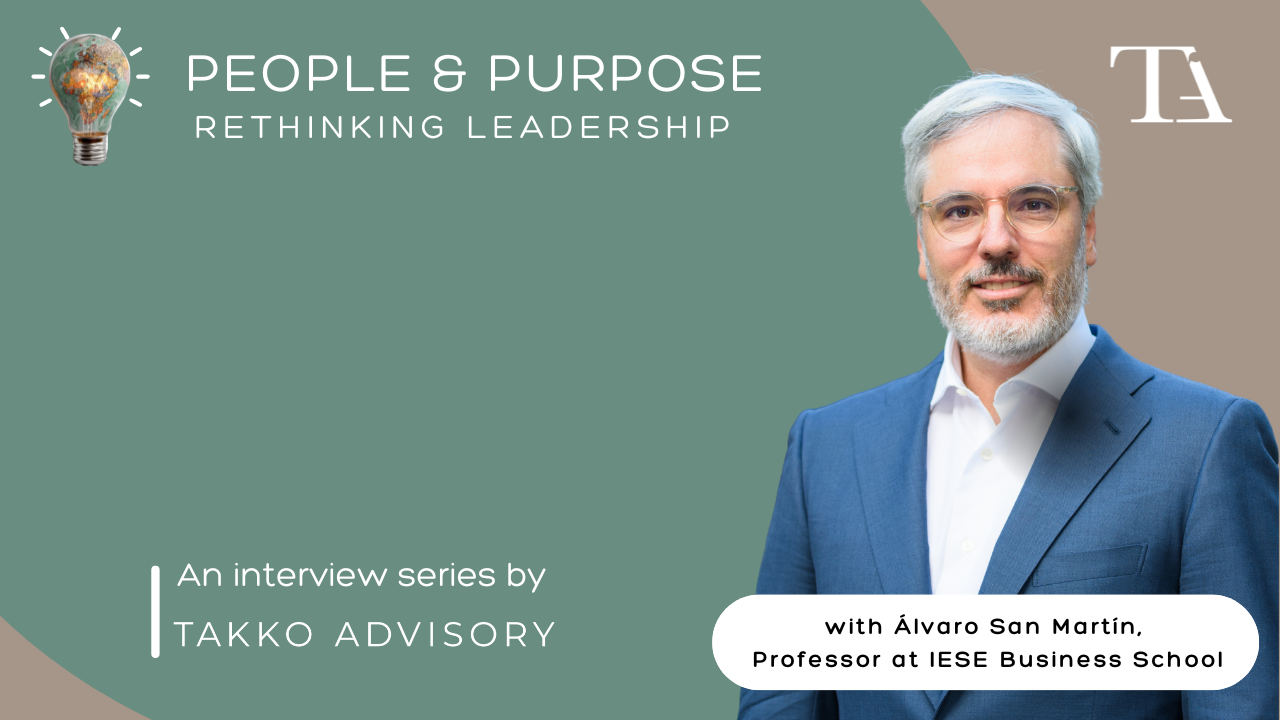
People & Purpose – Rethinking Leadership is an three-part interview series by Takko Advisory featuring leaders, academics, and thinkers who are shaping more human-centric, purpose-driven organizations. Through thoughtful conversations, the series explores how leadership, culture, and human behavior influence sustainable performance in an increasingly complex world.
Álvaro San Martín is a Professor at IESE Business School, specializing in organizational behavior and leadership. His research and teaching focus on motivation, purpose, trust, and human development at work, with particular attention to how leaders can create conditions that enable people and organizations to thrive. He regularly works with senior leaders across industries through executive education and advisory engagements.
In this first article based on an interview with Tarja Takko, CEO and Founder of Takko Advisory, San Martín shares why leadership today requires a human reset — and what it means to lead humans, not just organizations.
Article 1. From Power to Stewardship: Why Leadership Needs a Human Reset
Why control-based leadership is failing — and what human-centric leaders must do differently in a fast-changing world.
In a world of accelerating change, rising complexity, and increasing demands on human attention and energy, leadership itself is under pressure.
According to Álvaro San Martín, Professor at IESE Business School and expert in organizational behavior, the challenge leaders face today is not a lack of strategy or talent but a deeply outdated mental model of how humans work.
In an exclusive interview with Tarja Takko, CEO and Founder of Takko Advisory, San Martín describes this moment as one that calls for a “human reset in leadership”.
“When I think about a human reset in leadership,” San Martín explains, “I picture two very different mental models.”
The first, still dominant in many organizations, is built on power, control, hierarchy, and distrust. It assumes that people need to be monitored, decisions must sit at the top, and authority is the primary lever for performance. This model, he notes, is largely inherited from the industrial era.
The second model is fundamentally different. “It’s defined by influence, autonomy, stewardship, equality, and trust,” San Martín says. “Here, the leader is not a controller but a steward, someone who creates the conditions for others to do their best work.”
For San Martín, the human reset is precisely this shift in gravity, a shift from dominance to stewardship. What makes this shift urgent is the growing mismatch between old leadership assumptions and the reality of modern work. “Work today is highly cognitive, collaborative, and fast-changing,” he explains. “It depends on people’s capacity to learn, speak up, coordinate, and care,” he adds.
In such an environment, leadership based on control doesn’t just feel unpleasant; it actively undermines performance. Professor San Martín points to rising stress, disengagement, and quiet resistance not as signs of human fragility, but as symptoms of poorly designed systems.
“When leaders operate from dominance and distrust,” he says, “they suppress exactly the human capacities they need,” he argues.
By contrast, leadership grounded in trust and stewardship activates very different mechanisms: intrinsic motivation, identification with purpose, and a sense of fairness and belonging.
“That is the essence of the human reset; moving away from treating people as problems to be controlled and toward seeing them as partners to be trusted and enabled,” San Martín concludes.
This perspective closely mirrors Takko Advisory’s work with organizations undergoing transformation: sustainable performance begins with leadership mindsets that respect and understand how humans actually think, feel, and contribute.
The shift from control to stewardship is not theoretical — it is a leadership choice made every day.
At Takko Advisory, we support leaders in redesigning leadership models, and ways of working that build trust, autonomy, and accountability at scale — especially during moments of strategic change. If your organization is ready for a human reset in leadership, let’s start the conversation.