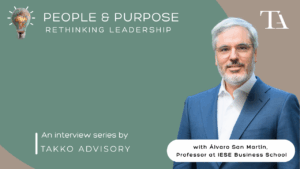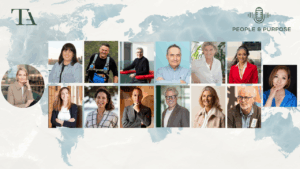
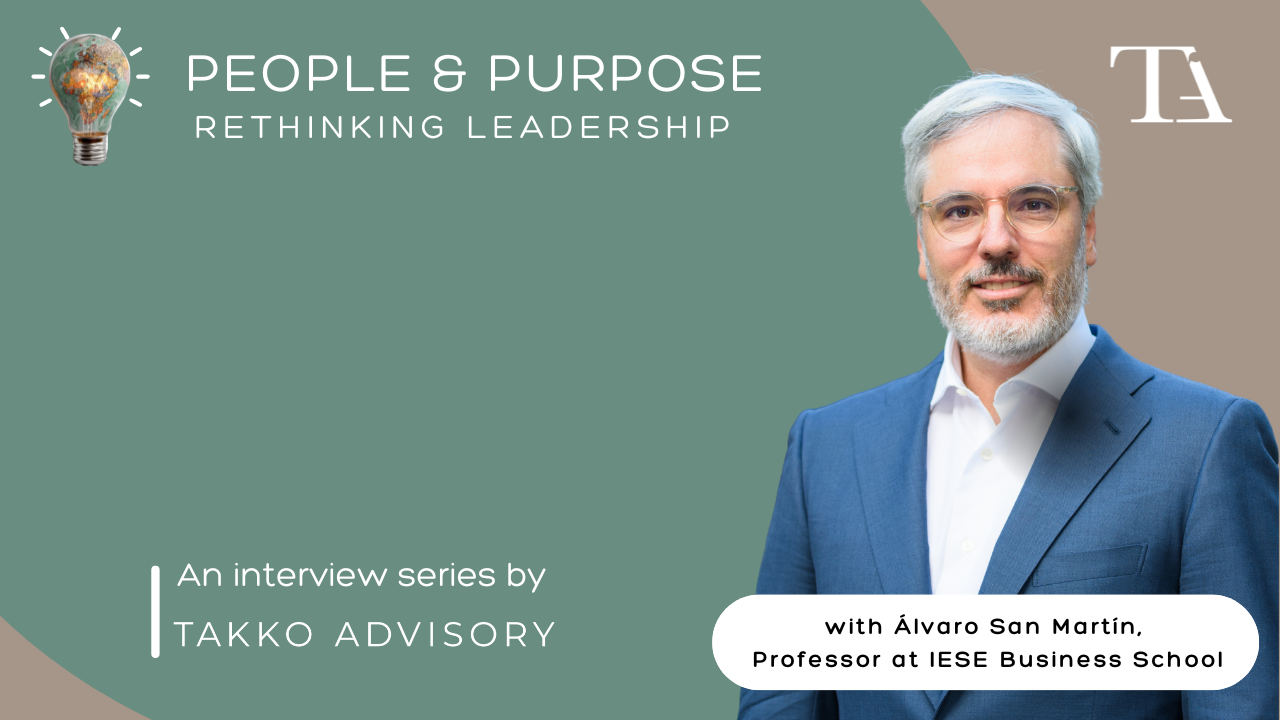
People & Purpose: Rethinking Leadership is an three-part interview series by Takko Advisory featuring leaders, academics, and thinkers who are shaping more human-centric, purpose-driven organizations. Through thoughtful conversations, the series explores how leadership, culture, and human behavior influence sustainable performance in an increasingly complex world.
Álvaro San Martín is a Professor at IESE Business School, specializing in organizational behavior and leadership. His research and teaching focus on motivation, purpose, trust, and human development at work, with particular attention to how leaders can create conditions that enable people and organizations to thrive. He regularly works with senior leaders across industries through executive education and advisory engagements.
In this third article in an interview with Tarja Takko, CEO and Founder of Takko Advisory, San Martín shares about he psychology of autonomy, trust, and intrinsic motivation — and why incentives alone will never unlock human potential.
Article 3. Purpose Is Not a Slogan: How Leaders Create Meaning That Lasts
Why purpose must be lived, not declared — and how leaders become meaning-makers in everyday work.
If motivation explains why people show up to work, purpose explains why they stay, persevere, and care, especially when work becomes difficult.
In his interview given to Tarja Takko, Álvaro San Martín describes purpose not as a slogan, but as a powerful psychological force. Drawing on Angela Duckworth’s work, he explains that purpose functions as a top-level goal, one that gives coherence to all other goals.
“When people have a clear top-level goal,” he says, “their daily tasks are no longer just isolated to-dos. They become part of a larger story.”
Without purpose, competing demands pull people in different directions: performance versus learning, career versus family, ambition versus contribution. Purpose integrates these tensions rather than eliminates them.
“Purpose makes effort feel less like a cost,” San Martín explains, “and more like an expression of who we are.”
Yet many leaders struggle to translate purpose into lived experience. “Employees often feel disconnected because they don’t truly share the purpose,” he notes. “It feels like somebody else’s story: the CEO’s story, the slide deck’s story.”
This is why hiring for values alignment matters as much as hiring for skills. “Competence can often be developed,” San Martín tells Takko. “A deep mismatch in values is much harder to fix.”
Beyond hiring, leaders play a crucial role as meaning-makers in everyday work. “Leaders cannot install meaning from the outside,” he says. “But they can help people see the human impact of what they do.”
Simple practices such as asking who was helped this week, sharing stories of impact, connecting daily work to real beneficiaries can quietly transform how people experience their roles.
Looking ahead, San Martín believes the future of leadership will depend increasingly on inner work: metacognition, emotional regulation, and intellectual humility.
“A leader who can notice ‘I’m getting defensive’ or ‘I might be wrong’ is far less likely to damage trust,” he explains. “This capacity directly shapes psychological safety.”
If he had to give CEOs one piece of advice, San Martín is clear: “Change how you show up in conversations.”
“Start with curiosity, not certainty,” he says. “Treat people as more resourceful and trustworthy than your systems assume. And make it safe to tell you the truth.”
In a volatile world, strategy and systems matter but they are downstream from leadership presence. As San Martín puts it, “If leaders consistently model humility, curiosity, and trust, many other changes begin to follow.”
Purpose only matters when it shows up in everyday decisions, behaviors, and conversations.
At Takko Advisory, we help organizations move from purpose statements to purpose in practice — through values-based leadership, culture development, and purpose-driven transformation. If you are ready to make purpose a lived experience rather than a tagline, let’s continue the dialogue.