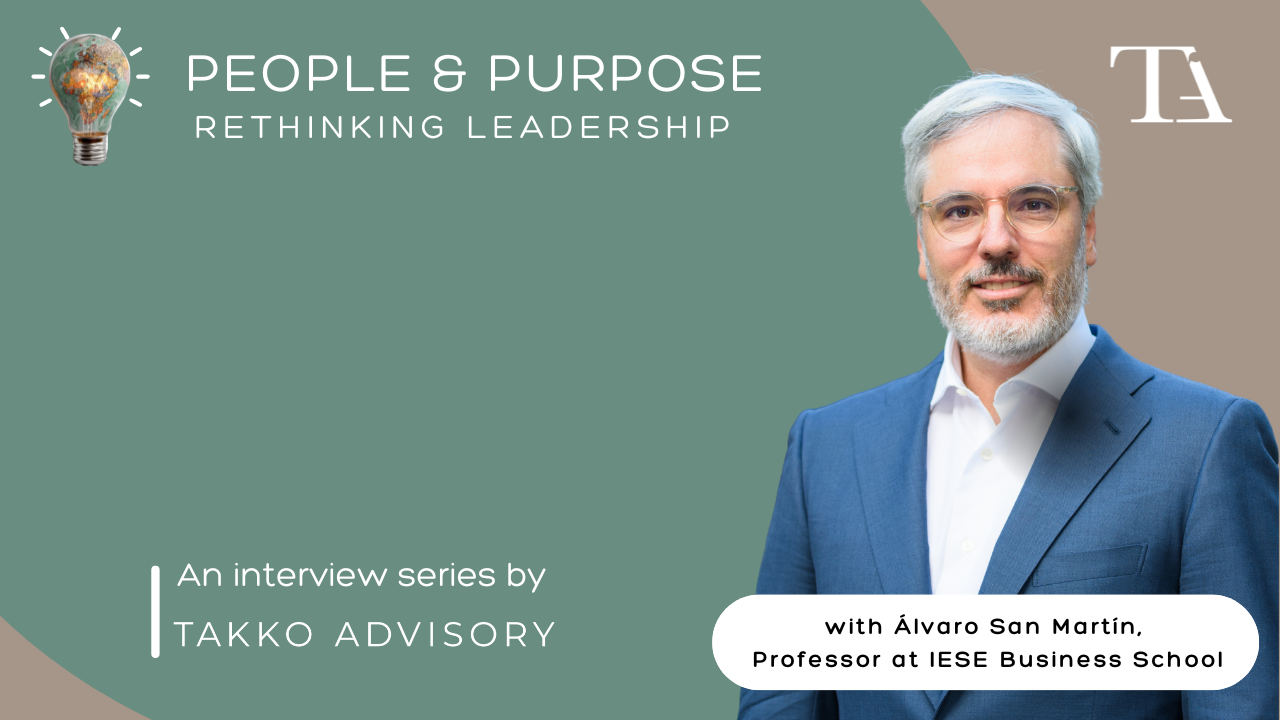
People & Purpose: Rethinking Leadership is an three-part interview series by Takko Advisory featuring leaders, academics, and thinkers who are shaping more human-centric, purpose-driven organizations. Through thoughtful conversations, the series explores how leadership, culture, and human behavior influence sustainable performance in an increasingly complex world.
Álvaro San Martín is a Professor at IESE Business School, specializing in organizational behavior and leadership. His research and teaching focus on motivation, purpose, trust, and human development at work, with particular attention to how leaders can create conditions that enable people and organizations to thrive. He regularly works with senior leaders across industries through executive education and advisory engagements.
In this second article from an interview with Tarja Takko, CEO and Founder of Takko Advisory, San Martín shares about he psychology of autonomy, trust, and intrinsic motivation — and why incentives alone will never unlock human potential.
Article 2. What Leaders Get Wrong About Motivation and Why It Matters
The psychology of autonomy, trust, and intrinsic motivation and why incentives alone will never unlock human potential.
One of the most persistent leadership blind spots, according to Professor Álvaro San Martín, lies in how leaders understand human motivation.
In his interview to Tarja Takko, San Martín is direct:
“One of the biggest misunderstandings is that leaders systematically overestimate the power of extrinsic motivators and underestimate intrinsic motivation.”
Many leaders, he explains, assume others are primarily driven by pay, bonuses, and status, while seeing themselves as motivated by learning, purpose, and impact.
Psychology even has a name for this bias. “The consequence,” San Martín explains, “is a leadership style that leans heavily on targets, incentives, and pressure, while investing too little in the conditions that actually sustain motivation over time.”
Drawing on Self-Determination Theory, he highlights three universal psychological needs: autonomy, competence (or mastery), and relatedness. These needs, he emphasizes, are not cultural preferences or generational trends; they are stable across societies.
“Autonomy is about having some control over how we do our work,” he explains. “Competence is the need to grow and feel effective. Relatedness is the need to feel connected and valued.”
When these needs are consistently supported, people tend to thrive. When they are frustrated, motivation and well-being suffer, regardless of role or seniority.
San Martín also challenges a second assumption: that people need to be tightly controlled because they are inherently untrustworthy.
“Leaders systematically underestimate how trustworthy people actually are,” he says. “Organizations often design systems to prevent misuse by a small minority, and everyone else pays the price in bureaucracy and lost autonomy.”
In reality, when leaders provide clarity, context, and trust, most people respond responsibly—and often creatively. “People are far more resourceful than we assume,” San Martín adds. “What blocks that resourcefulness is not a lack of talent, but fear, over-control, and micromanagement.”
For leaders, the implication is clear: motivation is not something to be engineered through incentives alone. It is something that emerges when systems respect human psychology.
“When leaders nurture autonomy, mastery, and purpose,” San Martín notes, “extrinsic rewards can play a healthy supporting role. But when those intrinsic drivers are ignored, no bonus is large enough to compensate for a sense of meaninglessness or disrespect.”
This insight sits at the heart of Takko Advisory’s leadership and culture work: building organizations that unlock human potential rather than constrain it.
Motivation cannot be forced. It must be enabled.